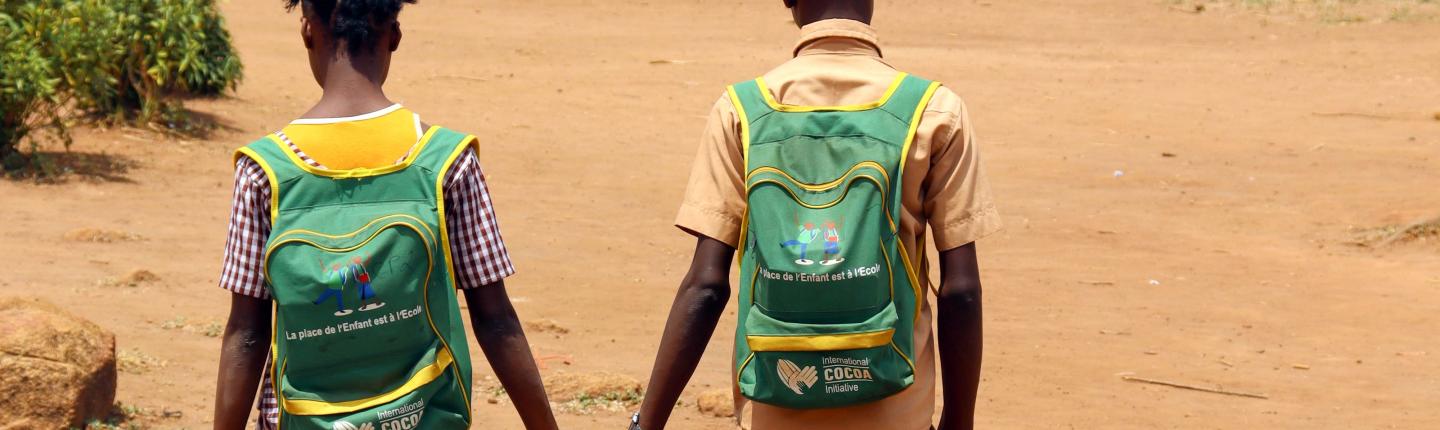
Providing school kits to primary school children in cocoa-growing communities in Ghana can improve educational outcomes and ease financial pressure on households, according to a new experimental study conducted in collaboration with ICI.
In cocoa-growing areas, school kits are commonly provided to children as part of support packages aimed at preventing and addressing child labour, including in the context of Child Labour Monitoring and Remediation Systems (CLMRS).
To assess the effects of distributing school kits to primary school children, researchers from ETH Zurich (NADEL) and the University of Ghana, in collaboration with ICI, conducted an experimental study in Ghana’s cocoa-growing communities.
The research was carried out as a randomised controlled trial involving 64 primary schools. In half of these schools, children in grades 5 and 6 received school kits, which included a school uniform, a pair of shoes, a school bag, a math set, and a set of stationery. Children, caregivers, and school head teachers were interviewed before and after the intervention to assess changes in educational outcomes, household spending, and labour practices.
Importantly, the study assessed the effects of school kits as a stand-alone intervention. Although in practice school kits are typically components of broader interventions that include other types of support, such as awareness raising and community-level support, it is useful to understand their effects in isolation.
School kits support children’s education
The study found that school kits led to improvements in children’s learning outcomes, particularly in mathematics. Children who received a school kit scored higher in maths assessments, with an average increase of 7.5 points (on a 100-point scale), while no significant effects were observed for English.
Effects on school attendance were more modest. School registers showed that children who received school kits attended school 2.5 more days (out of 48), equivalent to a 5% increase compared to children who had not received a kit.
School kits help households afford adult labour
The study also found that school kits reduced household spending on education, freeing up resources for other needs. This financial relief appears to have contributed to changes in household labour practices.
Households that received school kits reported hiring 0.56 more adult labourers for cocoa production compared to households that did not. This is an encouraging achievement in a sample where 60% of households do not normally employ any hired adult workers.
Interventions in isolation are not enough
While the study found some reductions in hazardous cocoa-related activities, the overall effects on child labour were weak. This highlights an important lesson: material support provided in isolation cannot reduce child labour on its own. Addressing child labour requires tackling multiple root causes and a sustained engagement with households and communities over time.
In practice, unlike in this study, school kits are rarely provided in isolation. They are usually part of broader support packages that can include awareness-raising, livelihood support, access to adult labour, and efforts to improve school quality. The rationale is that school kits would have stronger effects on child labour when integrated into these broader, comprehensive strategies.
Overall, the study showcases the contribution of school kits to improved educational outcomes and increased hiring of adult labour, while underscoring the importance of continuing to invest in holistic approaches to tackling child labour.