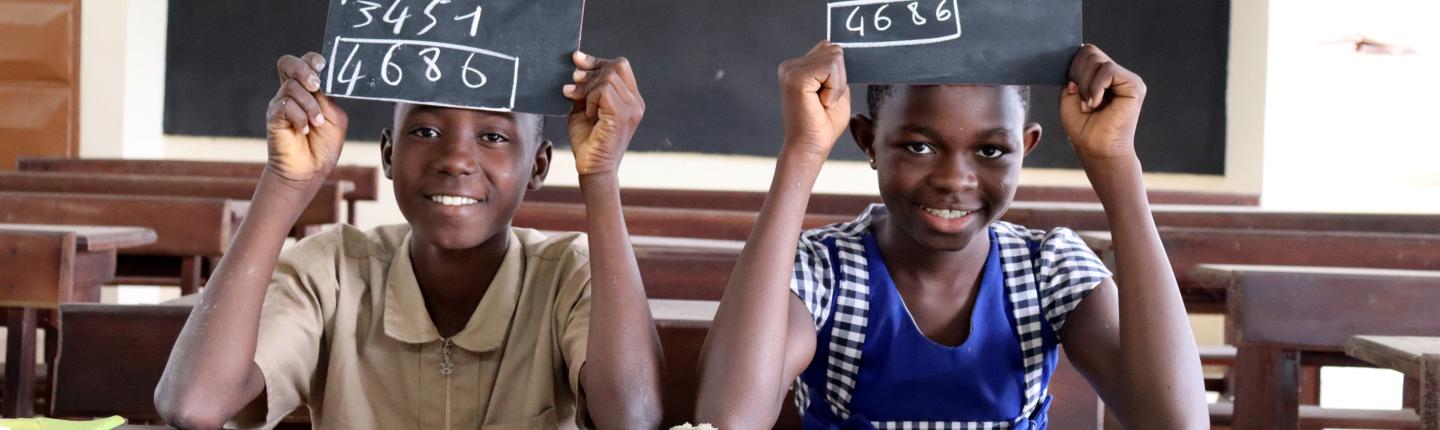
A message from ICI Executive Director, Matthias Lange, on the launch of ICI's 2025 Annual Report.
2025 was not an easy year for the cocoa sector. Last minute regulatory changes brought significant uncertainty, drastic cuts in development and international aid budgets affected many, and volatile cocoa prices added further strain to already complex market dynamics, with mixed, and unfortunately often negative, impacts on farmer livelihoods.
Nevertheless, I also reflect on a year of steady progress. Despite the uncertainty and challenges, ICI members and partners remained committed to raising the bar on our efforts to protect children from child labour and upholding human rights across cocoa-growing communities.
By September 2025, ICI members had supported 1.68 million children through Child Labour and Monitoring Systems (CLMRS), and coverage expanded to 1.33 million households across Cameroon, Côte d’Ivoire, Ghana and Nigeria. This expansion is impressive and reflects real commitment. We know, however, that it is important to also focus on improving the impact of these systems, in addition to ensuring they are practical, resilient and able to evolve as challenges and expectations continue to change.
Therefore, in 2025, a clear ambition for us has been to raise the standard across everything we do. This includes improving the effectiveness of the CLMRS, supporting implementers to operationalise the latest findings on what works to tackle child labour and forced labour, reinforcing national systems and strengthening institutional capacity.
This commitment was reflected in the publication of the CLMRS Core Criteria, which define minimum standards for system design and implementation, alongside the CLMRS Manual and Self-Assessment tool that will help implementers set up and run systems that fit these criteria and maximise impact. Sustainable change depends on robust, high-quality systems that work collectively to support children, families, farmers and communities.
We also focused on supporting others to have more impact. By harnessing years of pilot and research experience and turning these into practical tools and guidance, we have equipped partners with proven methodologies to strengthen their own systems. From training modules on protecting children from pesticide exposure to approaches addressing forced labour risks and new tools for data management and grievance mechanisms, our focus has been on turning learning into action. Through 25 knowledge-sharing sessions across West-Africa and beyond, as well as targeted one-to-one support, we have worked closely with members and stakeholders to ensure these tools are applied effectively in practice.
In a year shaped by regulatory uncertainty around the EU’s Corporate Sustainability Due Diligence Directive and Deforestation Regulation, and the transition towards implementation of the EU Forced Labour Regulation, we have continued to commit to higher standards whilst supporting all stakeholders to meet them. To achieve this, we worked in partnership with ECA and members to publish Recommendations for Guidelines on due diligence in relation to forced labour in the cocoa sector. As expectations across the sector evolve, ICI remains dedicated to ensure that systems not only meet these new benchmarks but translate them into tangible improvements in the lives of farmers and their families.
Our work continues to be rooted in collaboration. In 2025, we deepened partnerships with governments and national institutions in Ghana, Cote d’Ivoire and Cameroon, to strengthen social welfare systems, improve data coordination, and build capacity for more effective monitoring, support and follow up. These efforts are essential to creating integrated and interoperable systems to make sure that support really does reach those who need it most.
As we look ahead, our focus remains clear: to drive systemic change which is both scalable and sustainable. Through continued learning, partnership, action and innovation, we are expanding the reach and effectiveness of our work, bringing us closer to a future where every child is protected and able to thrive.
To find out more, please see the full Annual Report 2025.